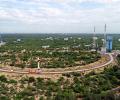
The Polar Satellite Launch Vehicle (PSLV) in its 63rd mission, would carry the earth observation satellite (EOS-09) which would be capable of capturing high-resolution images of the Earth's surface under all weather conditions.
ISRO is developing a third launch pad at Shriharikota to accommodate heavier satellites and next-generation launch vehicles. The new facility will support both crewed and uncrewed missions.
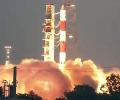
ISRO chairman announces plans for nine major launches by the end of the fiscal year, including the Blue Bird Block2 communication satellite for the US in collaboration with NASA.

In a landmark journey into a new era of space application, India successfully launched its first dedicated navigation satellite using the Polar Satellite Launch Vehicle, which blasted off from the Satish Dhawan Space Centre in Sriharikota, Andhra Pradesh.
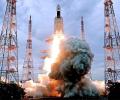
The 44.5-metre-tall, 295-tonne PSLV-C7 lifted off from the launch pad at 9.24 am.

Buying a mature rocket technology gives companies the designs and hardware know-how, but not necessarily the decades of engineering wisdom needed to make it work.

'The LVM3 rocket will orbit one Block 2 BlueBird satellite in Low Earth Orbit.'

The EoI comes at a time when ISRO is working to enhance LVM3's payload capacity to five tonnes in GTO and is also evaluating the procurement of a Russian semi-cryogenic engine for the vehicle's second stage.

The polar satellite launch vehicle's 52nd mission is scheduled for lift-off at 15.41 hours on Thursday from the second launch pad at the spaceport of Sriharikota 'subject to weather conditions'.
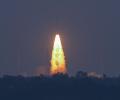
A PSLV rocket carrying Earth observation satellite EOS-09 failed to launch from the Sriharikota spaceport early on Sunday.

'It is not economical to operate GSLV-Mk II due to its cost and complexity. Future launches to be managed with LVM3.'

Thursday's launch is the last one of 2020 for ISRO.
The main focus of the all weather RISAT-1B satellite will be to observe the Indian land with its C-band synthetic aperture radar.

The larger question raised by the associations is simple: If ISRO is no longer to manufacture launch vehicles, what will happen to the institution's accumulated capabilities and the people who built them?
The heaviest communication satellite to be launched from the Indian soil onboard a new generation, homegrown 'Bahubali' rocket was successfully placed into the intended orbit on Sunday, the Indian Space Research Organisation said.

Based on the broadcast visuals, a rocket expert said the failure appeared similar to the anomaly seen during the PSLV-C61 mission.

India and the US on Wednesday marked their maiden space collaboration with the successful flight of a GSLV rocket that placed an earth observation satellite, jointly developed by the two space agencies, in a precise orbit.

This would be the 44th flight of the PSLV and the third launch by ISRO this year.

These upcoming launches carry added significance in light of setbacks suffered in recent years.

Noting that the PSLV was a versatile launch vehicle which can do different jobs and put satellites in different orbits, he said streamlining of this operation with improved capabilities is on.

ISRO has announced plans for seven launch missions by March, including the first uncrewed mission for the Gaganyaan project and demonstrations of new satellite technologies.

India's PSLV-C9 blasted off into space, carrying ten satellites including the country's latest remote sensing satellite CARTOSAT-2A, from Indian Space Research Ogranisation's Satish Dhawan Space Centre in Sriharikota on Monday.Scientists cheered as the Polar Satellite Launch Vehicle, in its thirteenth flight, soared into the clear sky in a perfect lift off at 9.23 am from the second launch pad.Besides the 690 kg CARTOSAT-2A, the PSLV is also carrying Indian Mini Satellite.

India is set to take its first steps towards its own human space flight when the uncrewed Gaganyaan mission soars to the skies later this year. Private players in the space sector are also gearing up for launching satellites on home-built rockets.

A rocket designed and developed by ISRO is being transferred to industry for production.
Nine ISRO associations want to know whether this is simply an effort to expand India's industrial capacity or part of a larger policy under which ISRO itself will eventually withdraw from rocket manufacturing.

The Indian Space Research Organisation (ISRO) on Monday successfully launched its maiden X-Ray Polarimeter Satellite that would offer several insights into celestial objects like black holes.
India on Monday successfully launched Israeli satellite 'Polaris' from the Satish Dhawan Space Centre in Sriharikota by a homegrown Polar Satellite Launch Vehicle, a spokesman of the Indian Space Research Organisation said. This is the second time that a 'core alone' PSLV configuration had put a satellite into orbit. In April 2007, an Italian satellite Agile was put into the orbit, the space agency spokesman said.
Indo-French oceanographic study satellite 'SARAL' and six foreign mini and micro spacecrafts were successfully launched on Monday by Indian Space Research Organisation's PSLV-C20 rocket from this spaceport.

EOS-01 is an earth observation satellite intended for applications in agriculture, forestry and disaster management support, ISRO has said.
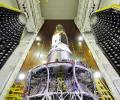
India will launch the PSLV-C56 carrying DS-SAR satellites from Singapore, along with six co-passenger satellites, from ISRO's Sriharikota spaceport on Sunday, July 30, 2023.

India's move to privatise PSLV rocket production through IN-SPACe has triggered debate over national security, ageing technology and the agency's role.

The 1,858 kg spacecraft, the country's first microwave remote sensing satellite, was injected into orbit by the Polar Satellite Launch Vehicle about 19 minutes after a perfect lift off at 5.47 am at the end of the 71-hour countdown from the Satish Dhawan Space Centre, around 90 km from Chennai.
The satellite will give India the capability to keep tabs on missile launches in its neighbourhood.

The launch is tentatively scheduled at 09.28 hrs IST on November 25, 2019 subject to weather conditions, ISRO said.
ISRO to launch EU satellite, earn $10 million

PSLV C-29 blasted off from the Satish Dhawan Space Centre, about 110 km from Chennai, at 6 pm and released the six satellites one by one into a 550 km circular orbit.

The 436-kg EMISAT and other satellites would be launched from the Satish Dhawan Space Centre in Sriharikota.

The Department of Space has directed that requests for voluntary retirement or resignation from Group 'A' Scientific and Technical personnel associated with the prestigious Gaganyaan human spaceflight programme and other important missions should not be accepted as a matter of routine.

ISRO stated that the disengagement of at least one contact -- in both the main and redundant paths -- of a connector led to the failure of NVS-02.
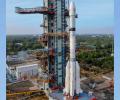
At 6.23 am on 29.1.2025, the 50.9 metre tall and weighing 420.7 ton Geosynchronous Satellite Launch Vehicle-F15 (GSLV-F15) is slated to blast off from the second launch pad carrying the 2,250 kg NVS-02 navigation satellite.

Indian Space Research Organisation's 101st mission from Sriharikota, an earth observation satellite onboard the agency's trusted Polar Satellite Launch Vehicle (PSLV) rocket, could not be accomplished on Sunday following a pressure issue in the third stage of the launch vehicle, the space agency said.
